
Duraflex Delta Loop End Steel Fiber: Multi-Directional Anchorage for Heavy-Duty Concrete
What Is Duraflex™ Delta Loop End Steel Fiber, and Why Does Anchorage Geometry Matter?
Quick answer: The Duraflex™ Delta Loop End Steel Fiber (patent applied) is a steel fiber reinforcement product by Kasturi Metal Composite Ltd, designed with an inverted loop-end anchorage that grips concrete from multiple directions instead of one. This multi-directional anchorage gives it higher pull-out resistance than conventional hooked-end fibers, making it suited for industrial flooring, tunnel linings, precast elements, and heavy-load pavements.
Key Takeaways
Anchorage type: Inverted loop-end (patent applied), engineered for multi-directional grip
Tensile strength: 1,850–2,300 MPa
Ductility: >1.4%
Residual flexural strength (Fr₃k): >4 MPa at <0.5% dosage by volume, per EN 14651
Standards compliance: EN 14889-1, ASTM A820 M04
Best for: Industrial flooring, pavements, precast, tunnel shotcrete/lining, railway sleepers, rock support
Why Does Fiber Anchorage Geometry Matter in Concrete?
Steel fibers reinforce concrete after cracking occurs — not by preventing the crack, but by bridging it and continuing to transfer load across the gap. How well a fiber does this depends almost entirely on its anchorage geometry, not its dosage rate alone.
A straight, unhooked fiber pulls out of the concrete matrix almost immediately once a crack forms, contributing little post-crack strength. A hooked or crimped end resists pull-out by mechanically locking into the matrix — but a standard hook only anchors well along a single plane. Since real cracks in a concrete slab propagate in multiple directions (due to point loads, dynamic traffic, or shrinkage stress), a single-plane anchor can under-perform once the load path shifts.
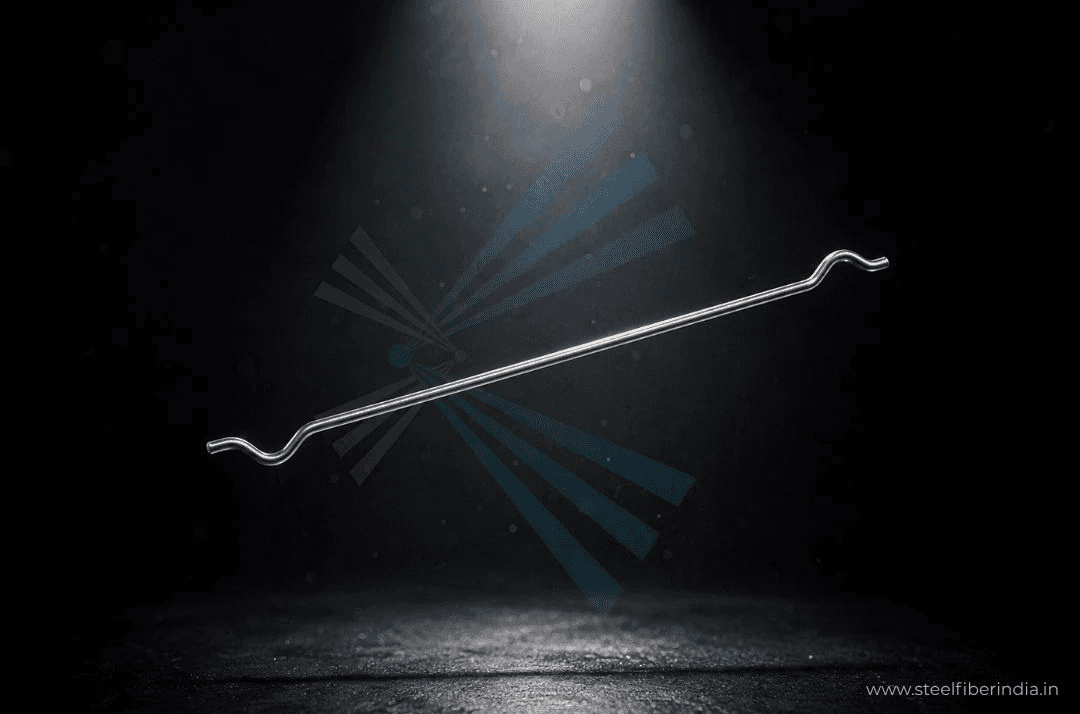
How Is the Delta Loop End Fiber Different From a Standard Hooked-End Fiber?
The Delta Loop End fiber uses an inverted loop-end shape instead of a single hook. This loop grips the surrounding concrete matrix from multiple angles at once, rather than locking along one axis — giving it true three-dimensional engagement with the matrix.
Practical effects of this design:
More consistent pull-out resistance across varied crack orientations, not just one plane
Reduced fiber balling during mixing, a common issue with high-aspect-ratio or densely hooked fiber designs
Higher post-crack load transfer, since the fiber stays anchored longer before failing
What Are the Technical Specifications of Duraflex™ Delta Loop End Steel Fiber?
Property | Value |
|---|---|
Tensile strength | 1,850–2,300 MPa |
Ductility | >1.4% |
Residual flexural strength (Fr₃k) | >4 MPa at <0.5% dosage by volume |
Test standard | EN 14651 |
Compliance | EN 14889-1, ASTM A820 M04 |
Format | Delta Loop End 60-35 |
Achieving Fr₃k above 4 MPa at less than 0.5% dosage by volume means less fiber is needed to reach the same post-crack performance target compared to lower-efficiency fiber geometries — which simplifies mix design and reduces material cost per cubic meter.
What Are the Benefits of Delta Loop End Steel Fiber?
Structural strength: Improved load-bearing performance across slabs, pavements, and precast elements
Crack control: Resists both early-age and long-term drying shrinkage cracking
Durability: Built for sustained industrial and heavy-load conditions
Multi-directional reinforcement: True 3D engagement throughout the slab, not just along a single plane
Construction efficiency: Reduced labor and faster installation vs. conventional reinforcement
Standards compliance: Conforms to EN 14889-1 and ASTM A820 M04
Where Is Delta Loop End Steel Fiber Used?
Industrial and warehouse flooring (rack loads, forklift traffic)
Roads and pavements under repeated dynamic loading
Heavy-duty slabs requiring high load transfer with reduced conventional reinforcement
Precast concrete elements needing higher tensile capacity
Tunnel shotcreting, tunnel lining segments, hydro-electric power tunnels
High-speed railway sleepers and rock support
Frequently Asked Questions
Is Duraflex Delta Loop End Steel Fiber patented? The product is patent applied for its inverted loop-end anchorage design, manufactured by Kasturi Metal Composite Ltd under the Duraflex™ brand.
What standard is used to test Delta Loop End fiber's flexural performance? Residual flexural strength (Fr₃k) is tested per EN 14651, and the product complies with EN 14889-1 and ASTM A820 M04.
How does Delta Loop End fiber compare to a standard hooked-end steel fiber? Standard hooked-end fibers anchor along a single plane. Delta Loop End fiber's inverted loop anchors from multiple directions, giving more consistent pull-out resistance regardless of crack orientation.
What dosage of Delta Loop End fiber is typically required? The product achieves Fr₃k >4 MPa at less than 0.5% dosage by volume — actual dosage depends on application and load requirements. Contact Kasturi Metal Composites for a project-specific recommendation.
Duraflex™ Delta Loop End Steel Fiber is manufactured by Kasturi Metal Composite Ltd, an ISO 9001:2015 certified company operating since 2005. Request a technical datasheet or dosage recommendation at steelfiberindia.in.